

Country Profile:
| Capital: | Abuja. | |
| Area: | 923,768 square km, a coastal state on the shores of the Gulf of Guinea, with Benin to the west, Niger to the north, Chad to the northeast, and Cameroon to the east and southeast. | |
| Population: | 108.9 million (1998), 183 (2025) | |
| Language: | English, many local languages | |
| Ethnic groups: | There are more than 250 ethnic groups in the country. These can be divided into four main groups: the Haussa and Fulani in the north, Yoruba in the southwest and the Igbo in the southeast. | |
| Religion: | A 1991 census put the population of the mainly Muslim north at about 47 million, compared with 41 million in the largely Christian south. | |
| Climate: | Relatively high temperatures throughout the year. August and September are the rainiest months throughout the country. | |
| Currency: | Naira. | |
| Time zone: | GMT +1 | |
| Public holidays: | 2001: Jan 1, March 6,Apr 13-16,
June 4, Oct 1, Dec 17, 25, 26
2002: Jan1, Feb 23*, March 29-April 1, May 24*, Oct 1, Dec 6*, 25, 26. *These holidays are dependent on the Islamic lunar calendar. |
|
| Electricity: | 220/250V AC | |
| Travel rules: | Passport valid for at least six months after period of intended stay required. Visa needed, together with documents required for the destination as well as return/onward ticket or sufficient funds. | |
| Driving: | International Driving Permit required. | |
| Health rules: | Yellow fever certificate required if arriving from or via infected areas. Hepatitis A, malaria, polio, tetanus, typhoid, yellow fever immunisation recommended. Hepatitis B and meningitis immunisation recommended in some circumstances, seek further advice. Malaria exists all year throughout the country. Chloroquine resistant. Risk of rabies. Precautions : Boil or sterilise drinking water and milk. All food should be well cooked. Avoid bathing in fresh water. | |
| (Source : The State of World Population 2000, UNFPA, NI World Guide 2001/2002, Europa World Year Book 2001) | ||
POLITICAL PROFILE |
||
| The federation of Nigeria won independence
from Britain and joined the Commonwealth on October
1, 1960. In November 1995, it was suspended from the
group for hanging nine minority rights activists in
defiance of world appeal for clemency.
Nigeria's political and economic development has been hampered by ethnic rivalry and a volatile religious mix. Its international reputation has been tarnished by corruption, drug smuggling and fraud. In 1966, after six turbulent years of civilian rule, army officers of the Igbo ethnic group -- the largest after the Hausa/Fulani in the north and Yoruba in the southwest -- staged a coup. Northerners staged a counter-coup in July 1966, and installed General Yakubu Gowon as head of state. The Igbos then declared the independent state of Biafra, triggering a civil war that ended in 1970 after up to one million people had died, many from starvation. After defeating the Igbos, a campaign of reconciliation started under Gowon, his successor General Murtala Muhammed and, later, General Olusengun Obasanjo, a southerner. In 1979, Shehu Shagari, a northerner, became the first civilian president in 13 years. The military ousted him on New Year's Eve 1983, accusing his administration of corruption. Shagari was succeeded by General Muhammadu Buhari, a stern northerner who jailed around 500 politicians, officials and businessmen, and embarked on an austerity campaign. Buhari fell in a coup led by General Ibrahim Babangida, another northerner widely acclaimed after Buhari's toughness. In 1986, Babangida introduced market reforms, freeing exchange and interest rates, leading to a sharp drop in the value of the naira currency, while lending rates rose to more than 40 percent. Economic tension exploded in riots in 1992 in Lagos, Nigeria's commercial centre after Abuja became the capital. Persistent Christian-Moslem frictions led to major clashes in the northern Kano State, where 3,000 people were killed. In June 1993, Babangida annulled presidential elections dubbed free and fair and widely believed to have been won by millionaire businessman Moshood Abiola, precipitating the worst political crisis in the country since the civil war. Babangida was forced to surrender power to an unelected industrialist, Ernest Shonekan, to complete the transition. But Shonekan was ousted by his defence minister, General Sani Abacha, who became head of state and set up a constitutional conference to draw up a new system of government. Abiola, backed by a coalition of politicians, retired army brass and pro-democracy activists, proclaimed himself president in 1994 at a secret gathering in Lagos. Abiola was arrested and charged with treason. The clamour for his release led to strikes set off by workers in the vital oil sector which dislocated fuel supplies with devastating consequences on transport, power, water and brought Nigeria to a standstill. In October 1996, Abacha announced a programme to hand over power to civilians in three year's time. Nigerian pro-democracy activists feared the transition from military rule could be jeopardised by politicians' attempts to postpone key elections until 1998. The country's five political parties asked the electoral commission and other agencies supervising the transition programme to consider delaying state assembly and governorships polls set for later this year and holding them along with federal polls in late 1998. The 1995 hangings of writer Ken Saro-Wiwa and eight other members of the Movement for the Survival of Ogoni Peoples for the murder of four pro-government Ogoni chiefs caused international isolation of Nigeria but not an embargo of its oil exports. Abacha died suddenly in June 1998, and General Abdulsalam Abubakar became
the new head of state. Abubakar released some prominent political prisoners but within a month of his elevation, Abiola died while still in detention, plunging the country into yet another crisis. Abubakar abandoned Abacha's discredited democracy programme; scrapped five political parties and the National Electoral Commission and announced new plans to restore civilian rule and hand power to a democratically elected government in May 1999. A 14-member electoral commission was appointed by Nigeria's military Provisional Ruling Council to oversee a plan to restore democracy by preparing guidelines and a timetable for elections to restore civilian rule. Polling for the country's 774 local councils was held in December 1998. The contest, the first free elections to be held since the annulled presidential elections in June 1993, resulted in a landslide victory for the centrist People's Democratic Party (PDP) formed in August. The PDP won a majority in elections for Nigeria's legislature in February 1999 and its candidate, former military ruler General Olusegun Obasanjo, won nearly two-thirds of the votes in the presidential elections. He was sworn in on May 29. The civilian government's introduction of sharia -- Islamic law -- in some northern states has divided Nigeria along religious lines. More than a thousand people died in sectarian bloodshed in the northern city Kaduna during 2000 as Christians and Moslems clashed over plans to proclaim sharia in Kaduna state. The Kaduna riots triggered revenge killings of Muslims in southeastern Nigeria. About half a dozen of the 19 states of the predominantly Muslim north have either adopted sharia law or are in the process of doing so. Youths in Kaduna petrol-bombed churches and Christian-owned shops in October 2001 in an area adorned with pictures of Saudi-born dissident Osama bin Laden, suspected by the United States of masterminding September 11 attacks in New York and Washington. Local community leaders in the northern city of Kano said that as many as 200 people were killed after anti-American protests in mid-October sparked violent riots.
Oil companies are moving activities offshore to avoid the unrest, and leaders worry it will scare away foreign investment. Nigerians fear the violence will escalate still further before elections in 2003. |
||
HUMAN DEVELOPMENT INDICATORS |
||
| Infant mortality: | 112 per 1,000 live births | |
| Maternal mortality ratio: | 700 per 100,000 live births | |
| Life expectancy: | 51.3 years male, 51.7 years female | |
| Illiteracy: | 28.7% male, 45.8% female above 15 years | |
| Access to basic care: | 10 percent | |
| Access to safe water: | 57 percent | |
| Human development index value: | 0.455 (1999) | |
| (Source: Human Development Report 2001, UNDP) | ||
ECONOMIC INDICATORS |
||
| GDP: | E N4.7 trillion (E$53 billion) (2000) | |
| Per capita: | $1,359 (1999) | |
| Growth: | 3.2 percent (2000) | |
| Inflation: | 5.9 percent (2000) | |
| Debt: | $29 billion | |
| Defence expenditure: | US$2.4 billion (2000) | |
| (Source: The Military Balance, 2001/2002, IISS) | ||
MILITARY STATISTICS |
||
| Armed forces: | Active: 78,500 men Reserves: Planned, none organised |
|
| Army: | 62,000 men with 50 main battle tanks, 100 light tanks. | |
| Navy: | 7,000 men with one frigate and 8 patrol and coastal vessels, including 2 Corvettes and 3 missile craft. | |
| Air force: | 9,500 men, 86 combat aircraft and 10 armed helicopters. | |
| (Source: The Military Balance, 2001/2002, IISS) | ||
COMMUNICATIONS |
||
| Civil aviation: | The principal international
airports are at Lagos, Kano, Port Harcourt, Calabar
and Abuja. There are 14 airports for domestic flights.
Lagos Murtala Muhammed International Airport is 22 km
northwest of Lagos. Nigeria Airways, state-owned, operates international flights. Bellview Airlines, privately-owned, operates domestic, intercontinental flights and along the West African coast. Chanchangi Airlines, privately-owned, operates domestic flights. |
|
| Railways: | There are about 3,505 km of mainly narrow-gauge railways. The two principal lines connect Lagos with Nguru and Port Harcourt with Maiduguri but services are subject to delays. | |
| Roads: | In 1996 the Nigerian road network totalled 193,198 km, including 2,044 km of motorways, 30,054 km of secondary roads; some 37,000km were paved. | |
| Telecomms: | A British Telecom subsidiary won a contract in 1997 to build and operate a high quality, reliable and low cost telephone network in Nigeria over the next five years. The company plans to install 150,000 lines during the first year. The contract is for a one million lines system by NITTI Company Ltd, which holds Nigeria's second national telecommunications operating licence. According to the National Communications Commission, there is a need for almost three million lines to meet both established and new demand in Nigeria. Nigeria also has a domestic satellite service aimed at business. The call-back telephone system has been declared illegal in the country and operators risk tough sanctions if caught. | |
|
|
||
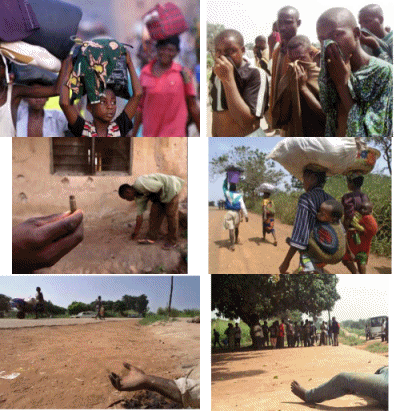 Tensions
were high in
Tensions
were high in
|
|
Write Your Comment
Search
Nigerian Government
The Federal Republic of Nigeria is governed in accordance with the provisions of a Constitution.In 1914 the Protectorates of Southern and Northern Nigeria were amalgamated with the Colony (Lagos) by Lord Lugard to form what is now known as Nigeria.
Nigerian Music
The music of Nigeria includes many kinds of Folk and popular music, some of which are known worldwide. Styles of folk music are related to the multitudes of ethnic groups in the country, each with their own techniques, instruments, and songs. Listen to music of Nigeria.